
The Science of Translucency—Why Some Veneers Look Fake (And How to Avoid It)
Part 3 of our comprehensive series on achieving natural-looking smile transformations
In Part 1 and Part 2 of our series, we explored Dr. Goodman’s philosophy of natural beauty enhancement and his three-tier approach to veneer preparation. Today, we’re diving into perhaps the most critical—yet most frequently overlooked—aspect of creating truly natural-looking veneers: translucency.
If you’ve ever seen someone with veneers that looked obviously fake, chances are the problem wasn’t the color or even the shape. More likely, it was the translucency—or lack thereof. Understanding this optical property is the key to distinguishing between veneers that scream “cosmetic dentistry” and those that seamlessly enhance natural beauty.
What Is Translucency and Why Does It Matter?
Translucency refers to how light is able to penetrate through an object. It’s the opposite of opaque, which blocks light completely. Natural tooth enamel is beautifully translucent, allowing light to pass through the outer layers and reflect back from the underlying dentin, creating depth, vitality, and that luminous quality we associate with healthy teeth.
Think about it this way: when you look at a natural tooth, you’re not seeing a flat, one-dimensional surface. You’re seeing multiple layers working together—the translucent enamel on the outside, the slightly more opaque dentin beneath, and the subtle variations in thickness and mineralization that create character and life.
This interplay of light is what gives natural teeth their distinctive appearance. When veneers fail to replicate this optical property, they look heavy, flat, and lifeless—no matter how white or perfectly shaped they might be.
The Problem with Opaque Veneers
One of Dr. Goodman’s most important rules of cosmetic dentistry directly addresses this issue: “Don’t make veneers too opaque.” Opaque veneers are among the most common mistakes in cosmetic dentistry, and they’re surprisingly easy to spot once you know what you’re looking for.
The Telltale Signs
Opaque veneers typically appear:
- Flat and lifeless: They lack the depth and vitality of natural teeth
- Too “white”: Not in terms of shade, but in their solid, chalky appearance
- Heavy-looking: They seem to sit on the face rather than integrate with it
- Uniform: They lack the subtle variations that make natural teeth interesting
- Artificial under certain lighting: Especially in natural sunlight or photography
The problem isn’t always that the veneers are too bright. You can have opaque veneers in any shade—even relatively dark ones. The issue is the lack of light transmission, which creates that characteristic “Chiclets” or “denture teeth” appearance that immediately signals cosmetic work.
Why Dentists Choose Opacity
It’s important to understand that dentists don’t choose opaque materials maliciously or out of ignorance. Often, opacity is used as a solution to mask severely discolored underlying teeth. If a patient has dark tetracycline staining or badly discolored natural teeth, an inexperienced dentist might think, “I need to block out this color completely.”
While this logic seems sound, it creates a trade-off: you may successfully mask the discoloration, but you sacrifice the natural appearance that translucency provides. The result is teeth that look “fake” despite being the desired shade.
This is where Dr. Goodman’s expertise becomes invaluable. With over 10,000 veneer cases, he has mastered the art of achieving both adequate coverage of underlying discoloration and natural translucency—a balance that requires exceptional skill and experience.
How Natural Teeth Interact with Light
To understand why translucency matters so much, we need to look at what happens when light encounters a natural tooth:
The Layered Effect
Natural teeth are composed of distinct layers, each with its own optical properties:
- Enamel: The outermost layer is highly translucent, especially at the incisal edge (the biting surface). This allows light to penetrate deeply.
- Dentin: The layer beneath the enamel is more opaque and provides the basic color of the tooth. It’s slightly yellowish, which actually contributes to the warmth and natural appearance.
- Pulp Chamber: The innermost living tissue, which doesn’t directly affect the optical properties we see but influences the overall vitality of the tooth.
When light hits a natural tooth, some reflects off the surface, some penetrates the translucent enamel and reflects back from the dentin layer, and some is absorbed. This complex interaction creates depth, dimension, and that characteristic “glow” that makes teeth look alive.
Color Variation and Gradients
Natural teeth aren’t uniform in color from root to tip. There are subtle gradients:
- Gingival third (near the gums): Typically more opaque and slightly darker
- Middle third: Transitional zone with moderate translucency
- Incisal third (biting edge): Most translucent, often with a slightly bluish or gray tint
These variations aren’t flaws—they’re features that contribute to the natural appearance. When veneers lack these subtle transitions, they look artificial and overly perfect.
Dr. Goodman’s Approach to Achieving Natural Translucency
Creating veneers with lifelike translucency requires more than just selecting the right porcelain. It demands a comprehensive understanding of materials science, artistic vision, and meticulous attention to detail throughout the fabrication process.
Material Selection
Not all porcelain is created equal. Dr. Goodman works exclusively with premium German porcelain and advanced ceramic materials like lithium disilicate, which closely mimic the optical properties of natural tooth enamel. These high-quality materials allow for the precise control of translucency that creates natural-looking results.
The porcelain must be strong enough to withstand normal biting forces while thin enough to allow appropriate light transmission. This balance is achieved through sophisticated material engineering that combines strength with aesthetics.
Layering Technique
Perhaps the most critical aspect of achieving natural translucency is the layering technique used during veneer fabrication. Dr. Goodman works in close collaboration with master laboratory technicians who understand how to build veneers in layers that replicate natural tooth structure.
This process involves:
- Base layers: Providing the fundamental color and adequate coverage of the underlying tooth
- Transitional layers: Creating gradual changes in opacity and color
- Surface layers: Highly translucent materials that allow light penetration
- Characterization: Adding subtle details like micro-cracks, white spots, or color variations
Each layer is carefully applied and fired, building up a veneer that has the same optical complexity as a natural tooth. This labor-intensive process is what separates exceptional veneers from mediocre ones.
Thickness Considerations
Another of Dr. Goodman’s cardinal rules addresses this directly: “Don’t make veneers too thick.” Thickness profoundly affects translucency. The thicker the porcelain, the more light is blocked, and the more opaque the final result appears.
This is one reason why Dr. Goodman has perfected minimal-preparation techniques that allow for incredibly thin veneers (as thin as 0.3mm). These ultra-thin restorations can achieve remarkable translucency because there’s less material for light to pass through.
However, achieving this requires exceptional precision. The veneer must be thin enough for optimal translucency but thick enough for adequate strength and coverage of the underlying tooth. This is where the harmony between dentist and laboratory technician becomes crucial—both must understand the optical goals and work together to achieve them.
The Incisal Edge: Where Translucency Matters Most
One of the most critical areas for achieving natural translucency is the incisal edge—the biting surface of the tooth. In natural teeth, this area is the most translucent, often appearing slightly blue-gray or even transparent.
This translucency at the incisal edge is what gives teeth their characteristic “depth.” When you look at someone’s smile, the interplay of light through these translucent edges creates dimension and visual interest.
Common Mistakes
Many dentists and laboratory technicians make the incisal edge too opaque, creating:
- Flat, lifeless tips: The edges look cut-off and artificial
- Excessive whiteness: The edges are as opaque-white as the body of the tooth
- Lack of depth: The teeth appear one-dimensional
Dr. Goodman’s Technique
Dr. Goodman ensures that the incisal edges of his veneers have appropriate translucency by:
- Specifying the exact optical properties needed for each patient
- Working with laboratory technicians who understand incisal characterization
- Creating subtle blue-gray tints or “halos” that mimic natural translucency
- Varying the translucency based on the patient’s age, natural tooth appearance, and aesthetic goals
The result is teeth that have the same play of light and shadow as natural enamel—edges that seem to disappear rather than announce themselves.
Beyond Translucency: The Complete Optical Picture
While translucency is crucial, it’s only one aspect of creating veneers that look truly natural. Dr. Goodman considers the complete optical picture:
Surface Texture
Natural teeth have microscopic texture—tiny ridges, slight irregularities, and subtle imperfections that affect how light reflects off the surface. Veneers that are too smooth and polished can appear artificial because they reflect light too uniformly.
Dr. Goodman ensures that his veneers have appropriate surface texture that creates natural light reflection. This doesn’t mean making them rough or dull—it means replicating the subtle texture of natural enamel that creates visual interest without appearing damaged or worn.
Luster vs. Shine
There’s a critical difference between luster and shine. Shine is the glossy, almost plastic-like reflectivity that makes poor veneers look fake. Luster is the soft, natural glow that healthy teeth possess.
Achieving luster rather than shine requires:
- Proper surface finishing techniques
- Avoiding over-polishing that creates excessive reflectivity
- Creating micro-texture that softens light reflection
- Understanding how the veneers will look under different lighting conditions
Color Depth and Variation
Even with perfect translucency, veneers can look fake if the color is too uniform. Dr. Goodman incorporates subtle color variations within each veneer:
- Warmer tones near the gum line
- Cooler tones toward the incisal edge
- Slight variations between adjacent teeth
- Characterization spots that add natural imperfection
These variations are incredibly subtle—often imperceptible when you look directly at the tooth. But they create optical complexity that registers subconsciously, making the veneers appear natural rather than manufactured.
Real-World Examples: Translucent vs. Opaque
Let’s look at what distinguishes natural-looking veneers from those that appear artificial:
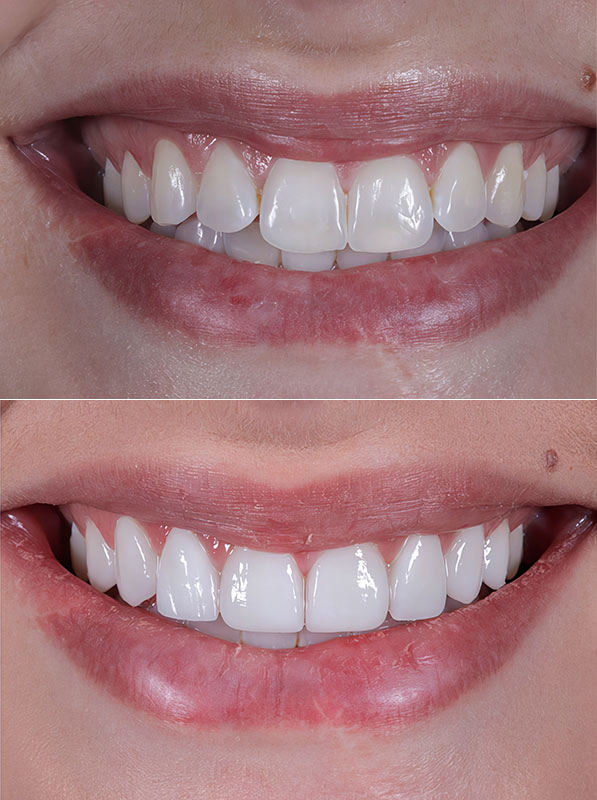
The Natural Appearance
Veneers with proper translucency exhibit:
- Depth and dimension when you look at them
- Subtle color variations from different viewing angles
- A luminous quality that suggests life and vitality
- Incisal edges that catch light naturally
- Integration with the face rather than sitting on top of it
When Dr. Goodman achieves this level of translucency, people notice that the patient looks great—but they don’t necessarily think “veneers.” They simply see an attractive, healthy smile.
The Artificial Appearance
Opaque veneers, by contrast, display:
- A flat, one-dimensional quality
- Excessive whiteness that looks chalky or painted
- Uniform appearance that lacks natural variation
- Heavy, prominent appearance on the face
- That telltale “I got veneers” look
The tragedy is that patients often pay significant amounts for veneers that advertise rather than enhance. This is why choosing an experienced cosmetic dentist with an understanding of optical properties is so crucial.
The Testing Phase: Ensuring Translucency Before Final Placement
One of the most valuable aspects of Dr. Goodman’s process is the try-in phase, where you can evaluate the translucency and overall appearance of your veneers before they’re permanently cemented. This is when you can see how the veneers interact with light, how they look from different angles, and whether they achieve the natural appearance you desire.
During this phase, Dr. Goodman evaluates:
- Translucency under different lighting conditions
- How the veneers look when you smile, talk, and laugh
- The integration with your facial features and natural teeth
- Your comfort and satisfaction with the appearance
Remember his guarantee: “If for any reason you are not happy with your veneers, simply let Dr. Goodman know before they are permanently cemented, and we will have them redone at no charge.” This commitment ensures that translucency and natural appearance are perfected before final placement.
The Bottom Line: Translucency Is Non-Negotiable
In the world of cosmetic dentistry, translucency is what separates good veneers from exceptional ones. It’s the quality that makes the difference between enhancement and obvious dental work, between natural beauty and artificial perfection.
Dr. Goodman’s commitment to achieving proper translucency stems from his fundamental philosophy: veneers should enhance your natural beauty, not announce themselves. When translucency is done right, your veneers become an invisible enhancement—people see your beautiful smile, not your cosmetic dentistry.
In our next installment, we’ll explore the facial harmony principles that guide veneer design—including the famous golden proportion and when NOT to apply it. We’ll examine how Dr. Goodman considers your entire face, not just your teeth, to create smiles that enhance your overall appearance and create true aesthetic balance.
This is Part 3 of our comprehensive series on achieving natural-looking smile transformations with Class-1 veneers. Read Part 1 to learn about Dr. Goodman’s philosophy of facial harmony and Part 2 to understand the three-tier approach to veneer preparation. Stay tuned for Part 4, where we’ll explore facial harmony principles.
Ready to experience the difference that proper translucency makes? Contact Dr. Goodman’s Beverly Hills office at 310-860-9311 to schedule your personalized consultation. With mastery of optical properties and collaboration with world-class laboratory technicians, Dr. Goodman creates veneers that look indistinguishable from natural teeth.